- Tsuba - Ko-Shoami Sasano Masayuki Hakogaki
- Tsuba - Ko-Shoami Sasano Masayuki Hakogaki
Couldn't load pickup availability
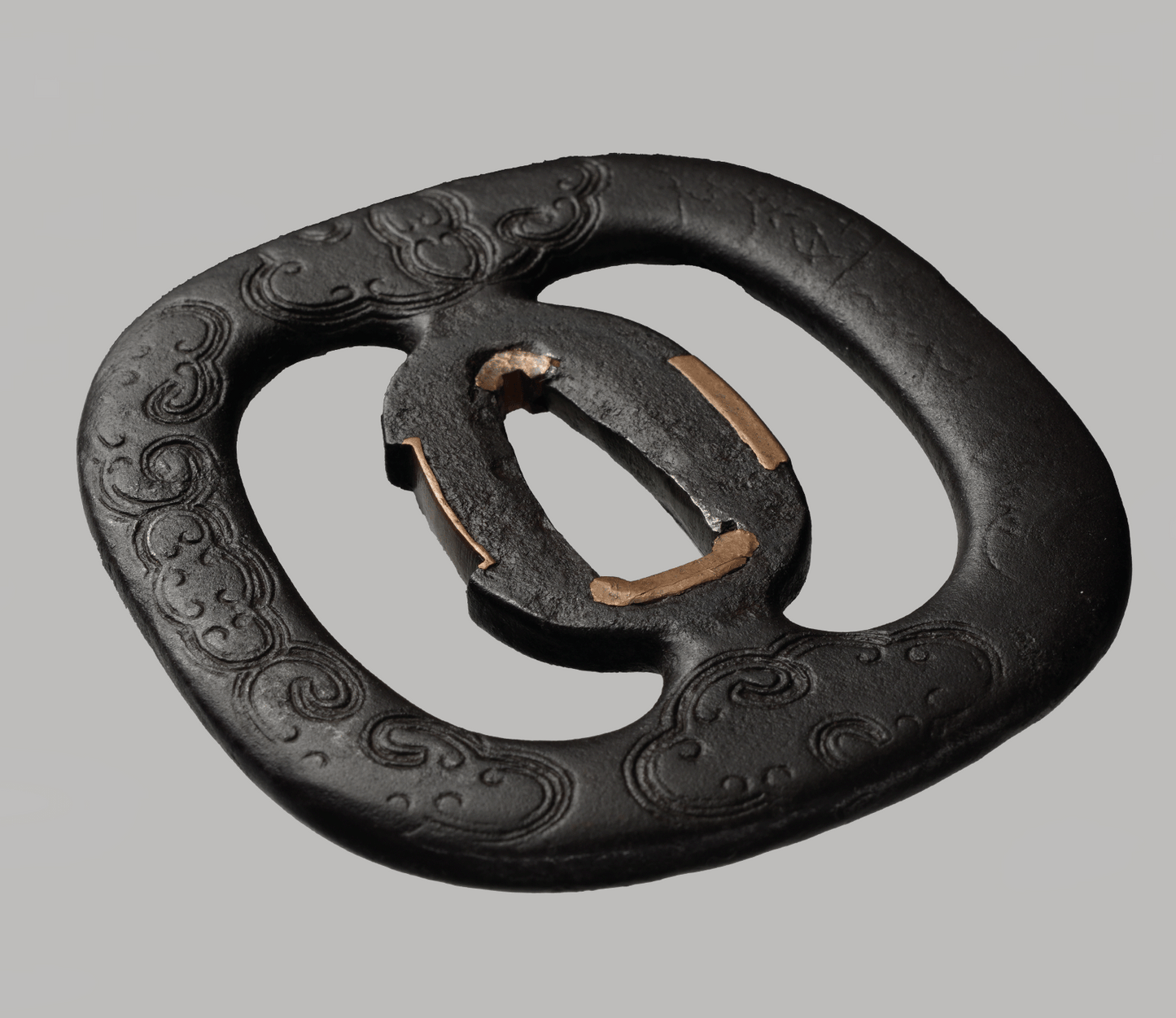
Tsuba – Ko-Shōami
Unsigned: Ko-Shōami
Namako-sukashi (Sea Cucumber Openwork) with Arabesque Clouds
Momoyama period (late 16th – early 17th century)
Dimensions: 74.0 mm (h) × 82.3 mm (w) × 4.6 mm (seppa-dai), 5.4 mm (mimi)
Weight: 137.0 g
Description
This powerful Ko-Shōami tsuba belongs to the late Momoyama aesthetic, when sword fittings emphasized bold silhouette, refined iron, and restrained ornament over elaborate pictorial decoration. The plate has an elegant outline, while the large central openings create the characteristic namako-sukashi ("sea cucumber") design from which this type derives its name.
The iron is dense and well forged, displaying the compact, slightly glossy surface prized in early Shōami work. Delicately engraved karakusa (scrolling arabesques) decorate portions of the rim, providing a subtle contrast to the otherwise austere composition. The sparse decoration enhances rather than diminishes the strength of the plate, reflecting the refined taste that emerged during the transition from the Momoyama to the early Edo period.
The namako motif has long been associated with resilience and longevity. Sea cucumbers were regarded as valuable delicacies and auspicious offerings, while the flowing arabesques symbolize perpetual growth and continuity. Together they create a design that balances martial simplicity with cultivated elegance.
The substantial weight, carefully finished rim, and harmonious proportions exemplify the finest characteristics of early Ko-Shōami workmanship, where beauty is achieved through purity of form rather than elaborate embellishment.
Translation of the Hakogaki
The inscription on the storage box reads approximately:
海鼠透
Namako-sukashi
無銘 桃山作
Unsigned, made in the Momoyama period.
鉄地(…)
Iron plate (the following descriptive characters are partially obscured in the photograph and appear to describe the plate and decoration).
古櫃 佳作
An excellent example of early workmanship.
鑑定両家・神無月
Authenticated by both appraisal families, Kannazuki (October).
(This is likely the dating or notation used by the appraiser.)
素心鑑 (seal)
Appraised by Sasano Masayuki
Comments on the Hakogaki
The attribution is significant because it identifies the tsuba not simply as Ko-Shōami, but specifically as a Momoyama-period work. The wording 佳作 (kasaku)—"an excellent work"—is a term experienced appraisers reserve for pieces regarded as particularly successful representatives of their school rather than merely typical examples.
The appraiser's seal 素心鑑 (Soshin Kan) belongs to Sasano Masayuki (笹野正之), one of the foremost authorities on early iron tsuba in the 20th century. A hakogaki by Sasano substantially enhances both the scholarly interest and desirability of an early Ko-Shōami guard, as his expertise focused precisely on Momoyama and early Edo iron tsuba. His attribution therefore carries considerable weight, even independent of modern NBTHK papers.
Dimension
74,0 mm x 82,3 mm x 4,6 mm (Seppa) - 5,4 mm (Mimi), 137,0 g
Share