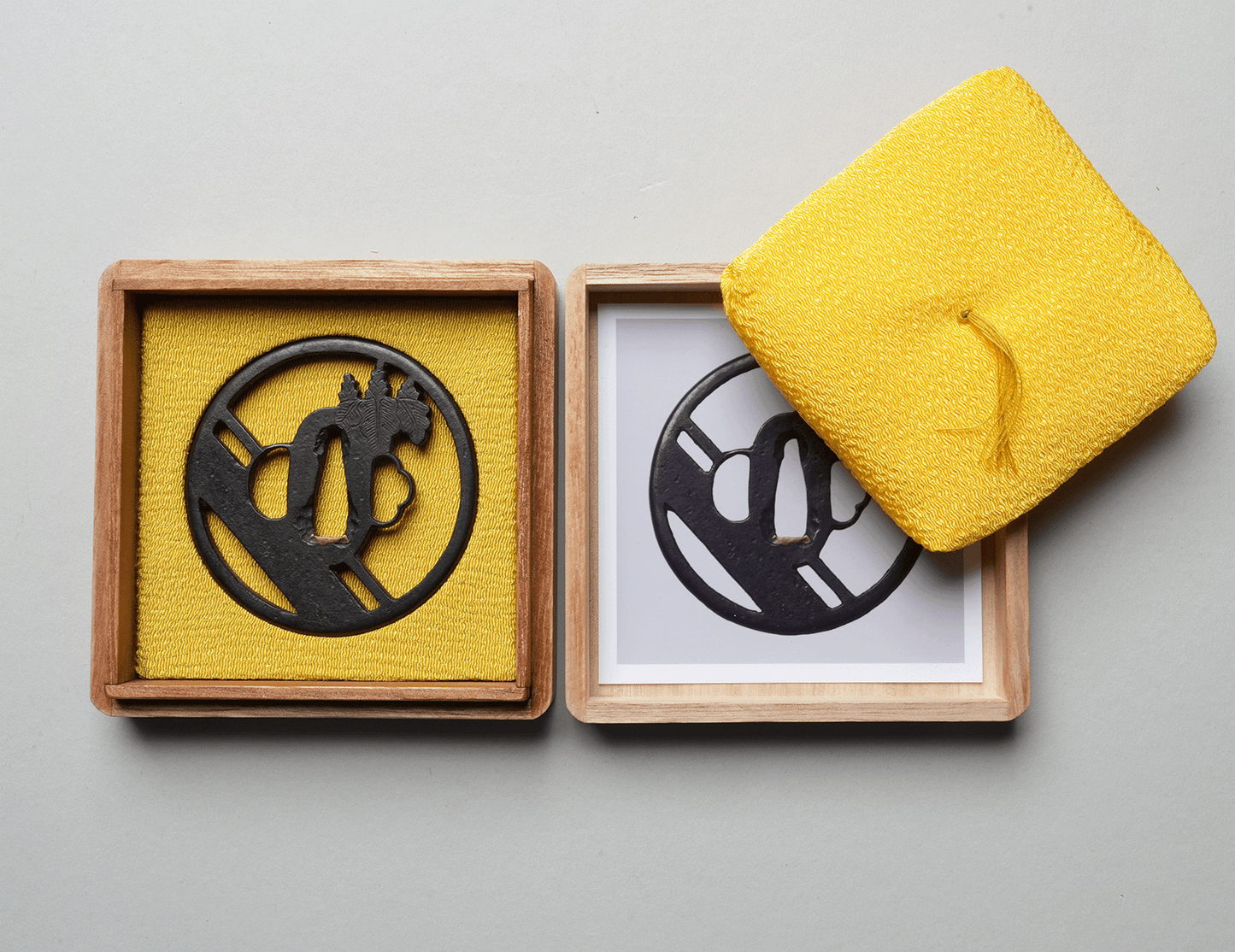
Tsuba - Higo Kirimon 5-7-5 with Taste of Akasaka
Tsuba - Higo Kirimon 5-7-5 with Taste of Akasaka
Couldn't load pickup availability
This tsuba displays a soft, subdued presence enhanced by its deep brown patina. It exemplifies the refined, slightly melancholic aesthetic associated with the appreciation of transience in Japanese art.
Created for a samurai entitled to wear the double kirimon (5–7–5), the piece harmoniously balances diagonal parallel stripes with a chrysanthemum motif. The bars—executed as futatsu-hikiryō (二引両), or “double-line” designs—belong to a motif type traceable from the early Muromachi period through the Edo period, appearing in traditions such as Tosho, Shoami, Owari, and later Akasaka, Kyō-sukashi, and various Higo schools. The same symbolic pairing of thick and thin lines is also known in classical textile patterns (katako mochi jima, 片子待縞), often called “parent and child stripes.”
Although their precise meaning remains uncertain, several interpretations may illuminate the intention behind these parallel bars:
Duality and relationship: The two lines, traveling side by side without crossing, can represent entities of the same kind but of unequal status—parent and child, teacher and student, senior and junior, or a pair aligned in shared purpose. The contrast in thickness may symbolize generational continuity or the transmission of knowledge and responsibility.
Enduring alliance: The stripes may signify a partnership in which one figure is strong and prominent while the other is subtle yet supportive—two companions advancing together with mutual respect.
Natural imagery: Another possibility is that the stripes evoke drifting clouds, with variations in thickness suggesting atmospheric depth and distance.
Through its interplay of form, symbolism, and patina, this tsuba captures both elegance and introspective beauty characteristic of Higo and Akasaka taste.
Dimension 77,1mm x 78,8mm x 4,6 mm (4,6 mm) 93,8 g
Share