Tsuba - Owari Sukashi with Matsudaira Aoi Mon (三つ葉葵)
Tsuba - Owari Sukashi with Matsudaira Aoi Mon (三つ葉葵)
Couldn't load pickup availability
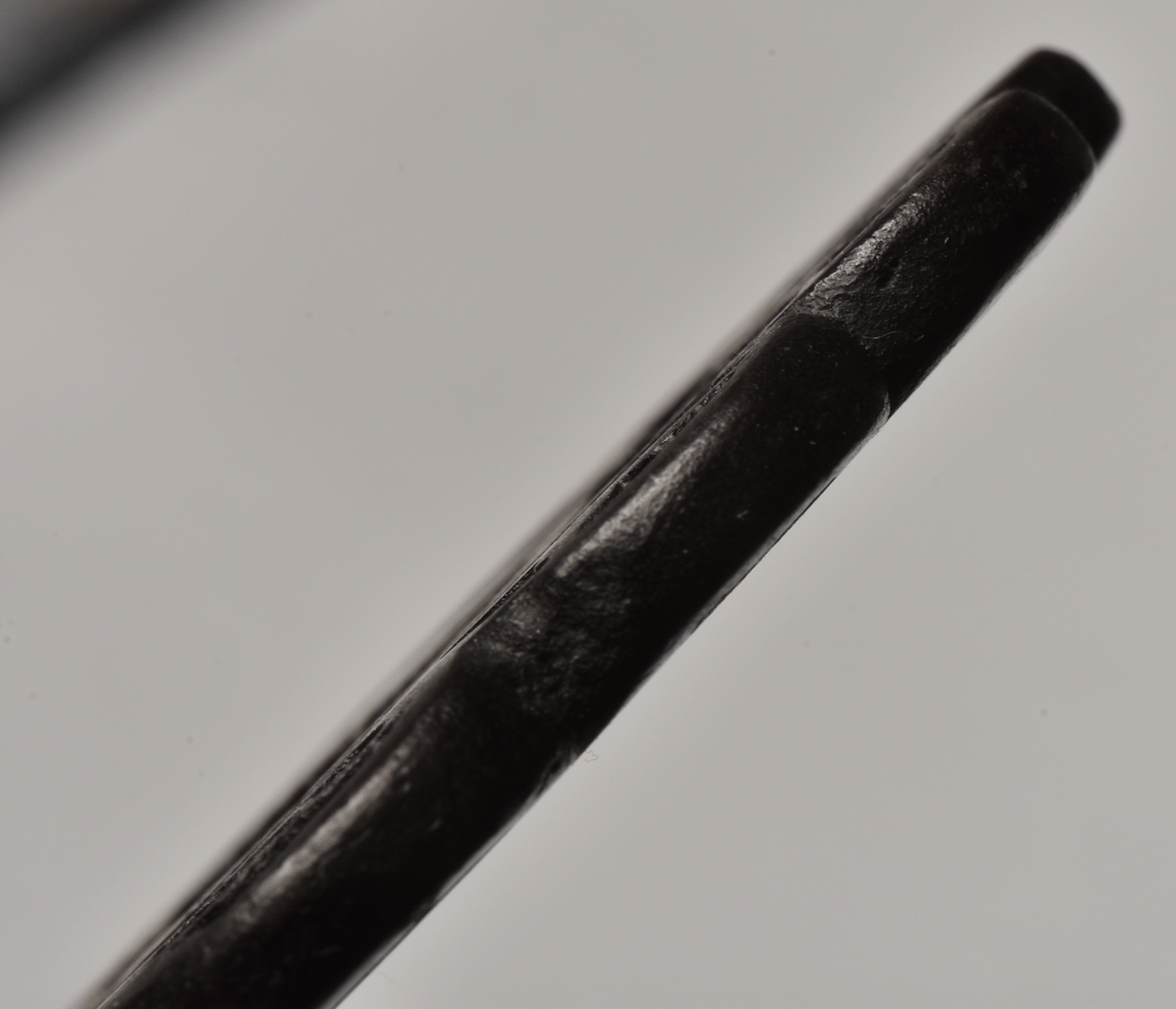
An elegant Owari-school sukashi tsuba, forged in dense, well-finished iron with the characteristic power and clarity associated with early Owari workmanship. The plate is subtly mokko-gata, with a rounded square silhouette and a robust kakumimi koniku rim exhibiting well-controlled volume and a uniform, confident edge treatment.
At the hitsuana, it features a Matsudaira mon (likely the Matsudaira “triple hollyhock” / aoi mon) incorporated into the kozuka / kōgai hitsu-ana area. This mon motif is cleanly articulated, forming a visual anchor for the entire composition.
Surrounding the plate are twelve mons arranged in a circular formation, each rendered in bold iron-sukashi. The circular symmetry and strong, thick sukashi bridges are hallmarks of Owari design, giving the piece a sense of structural balance and martial gravity.
Analysis of the Family Mons
Based on your description:
central Hitsu-ana Motif:
Matsudaira Aoi Mon (三つ葉葵)
Incorporated into the hitsu-ana, this identifies a connection—symbolic or commissioned use—with the Matsudaira/Tokugawa line. Owari tsuba with mon motifs are well-documented, often used to express allegiance or family identity.
Twelve Perimeter Mons:
While specific identification requires a visual reference, the described configuration corresponds to the Owari tradition of mon-pattern sukashi, often using stylized:
- mokko-gata variations
- abstracted mokko-mon, aoi-mon, kiri-mon, or kikyō-mon forms
- symmetrical heraldic shapes arranged to create a radial design
The presence of twelve uniform mons suggests a symbolic cycle or protective ring, a theme found in several late-Muromachi Owari works.
The overall composition—central mon paired with a ring of heraldic emblems—is consistent with Owari family-mon tsuba, conveying status, lineage pride, and a disciplined aesthetic typical of the school.
Workmanship Characteristics
Iron Quality:
Deep, rich patination with the fine granular surface typical of Owari iron.
Sukashi Technique:
Strong, thick bridges with no fragile thin lines—one of the defining contrasts to contemporaneous Kyō-sukashi work.
Symmetry:
The design aligns perfectly along both vertical and horizontal axes, meeting the Owari preference for structural balance and clarity.
No Figurative Motifs:
In accordance with Owari taste, the tsuba relies strictly on abstract and heraldic forms; no human or narrative elements are present.
Attribution
The combination of:
- mokko-form,
- bold iron-sukashi,
- mon-based design,
- strong rim with slight seppa-dai drop,
- and the balanced four-directional layout
supports an attribution to the Owari School, late Muromachi to early Edo period.
Summary
A refined and dignified Owari sukashi tsuba featuring the Matsudaira crest within the hitsu-ana and a striking ring of twelve heraldic mons surrounding the plate. This piece exemplifies the power, symmetry, and disciplined design language of the Owari tradition, making it a highly desirable example for collectors of mon-themed sword fittings.
Dimension 76,1 mm x 78,3 mm x 5,0 mm (4,4 mm) 92,8 g
Share