Tsuba Akasaka Tadafusa - NBHTK Tokubetsu Kicho Token
Tsuba Akasaka Tadafusa - NBHTK Tokubetsu Kicho Token
Couldn't load pickup availability
This tsuba, attributed to the Akasaka School, most probably a work of Tadafusa, presents a visually striking composition in which negative space and iron carving work together to form a vivid, narrative scene. The guard features an openwork (sukashi) design depicting a dragon among clouds, a motif clearly suggested by the flowing, sinuous shapes and the sharply defined, curling elements. The dragon’s body is rendered in an elegant, elongated curve, while the surrounding cloud forms create a dynamic sense of movement swirling around the central aperture. The iron plate is well-forged, dense, and smoothly finished, showing the refined craftsmanship associated with Edo-period specialist makers.
Another interpretation might be depicting a large Pine Tree spanning widely - somehow I like the dragon theory.
Symbolically, the dragon represents power, wisdom, protection, and supernatural authority—a guardian figure often favored by samurai wishing to embody strength tempered by intelligence. The cloud formations reinforce the sense of ascension and transcendence, suggesting that the bearer aligns himself with higher ideals and forces beyond the mundane. The contrast between the fluid forms and the strong iron plate echoes the duality at the heart of the warrior’s path: controlled power guided by clarity of mind.
A samurai might have chosen this tsuba to express personal aspiration, spiritual protection, or an affinity with the dragon as a symbol of elevated status. Dragons were commonly linked to leadership and strategic insight—qualities that would resonate with a commander, administrator, or a samurai of scholarly inclination. The piece also communicates refinement and cultured taste, marking its owner as someone who appreciates both martial symbolism and artistic sophistication.
Probable school and dating:
Akasaka School, Tadafusa, mid Edo period. The clean carving, elegant sukashi work, and balanced spatial composition align well with the stylistic tendencies of later Edo metalworkers associated with the Akasaka and Higo schools.
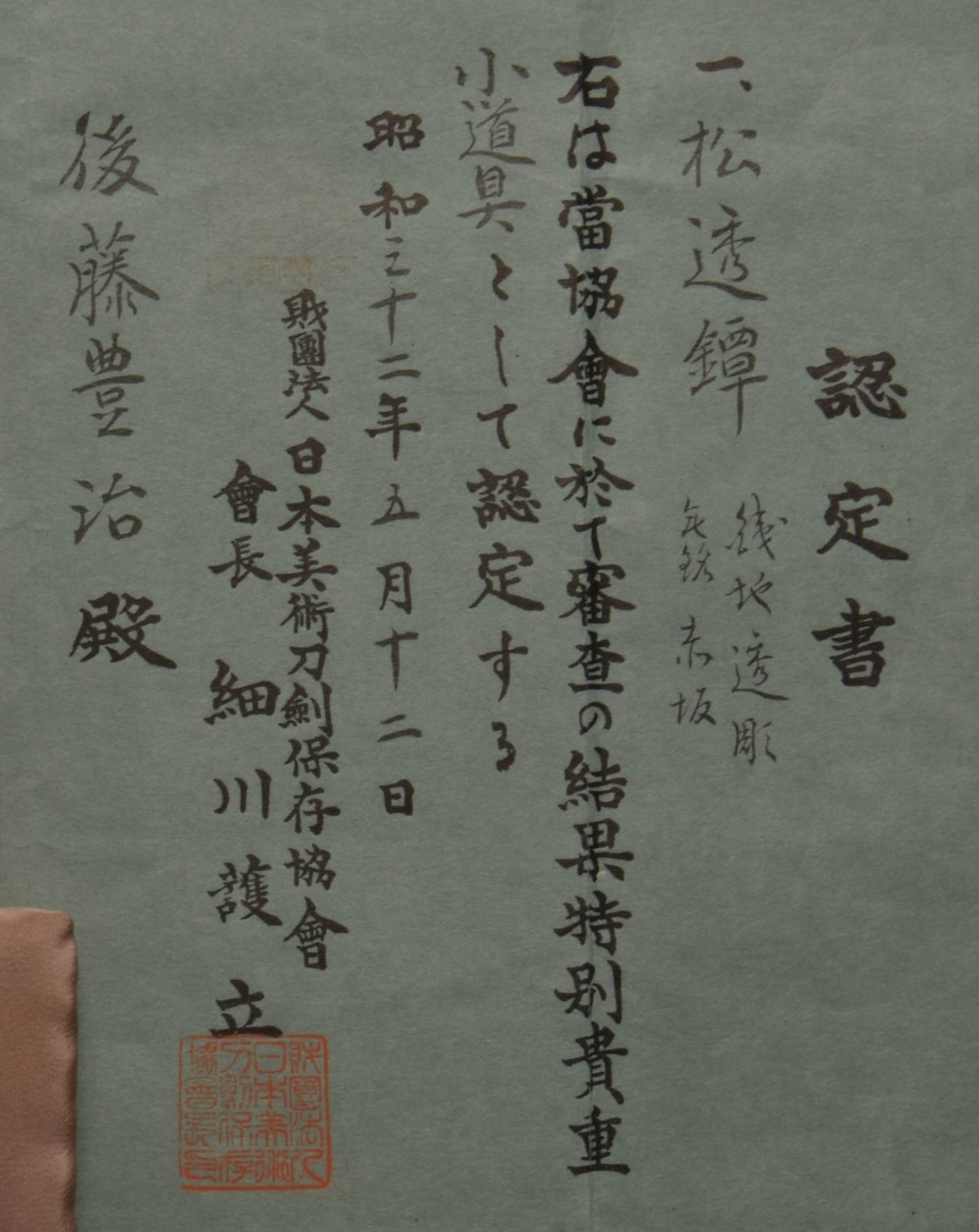
Certificate of Authentication
(1) Matsu-sukashi tsuba (松透鐔)
(small marginal note: iron ground, openwork carving (鉄地 透彫) — faint)
The above item has been examined by this Association and, as the result of that examination, is certified as a “Tokubetsu Kichō” (Specially Precious) small accoutrement (kodōgu / small sword fitting).
Date: 12 May, Shōwa 52 (12 May 1977)
Incorporated Association — Japan Society for the Preservation of the Japanese Art Sword
Chairman: Hosokawa Moritatsu (細川護立) 〔seal〕
To: Mr. Gotō Toyoharu (後藤豊治 殿)
Dimension 67,6, mm x 71,8 mm x 5,3 mm (5,1 mm) 87,2 g
Share