Tsuba - Certificat Futakoyama kumo-mon (雲文) NBTHK Hozon
Tsuba - Certificat Futakoyama kumo-mon (雲文) NBTHK Hozon
Impossible de charger la disponibilité du service de retrait
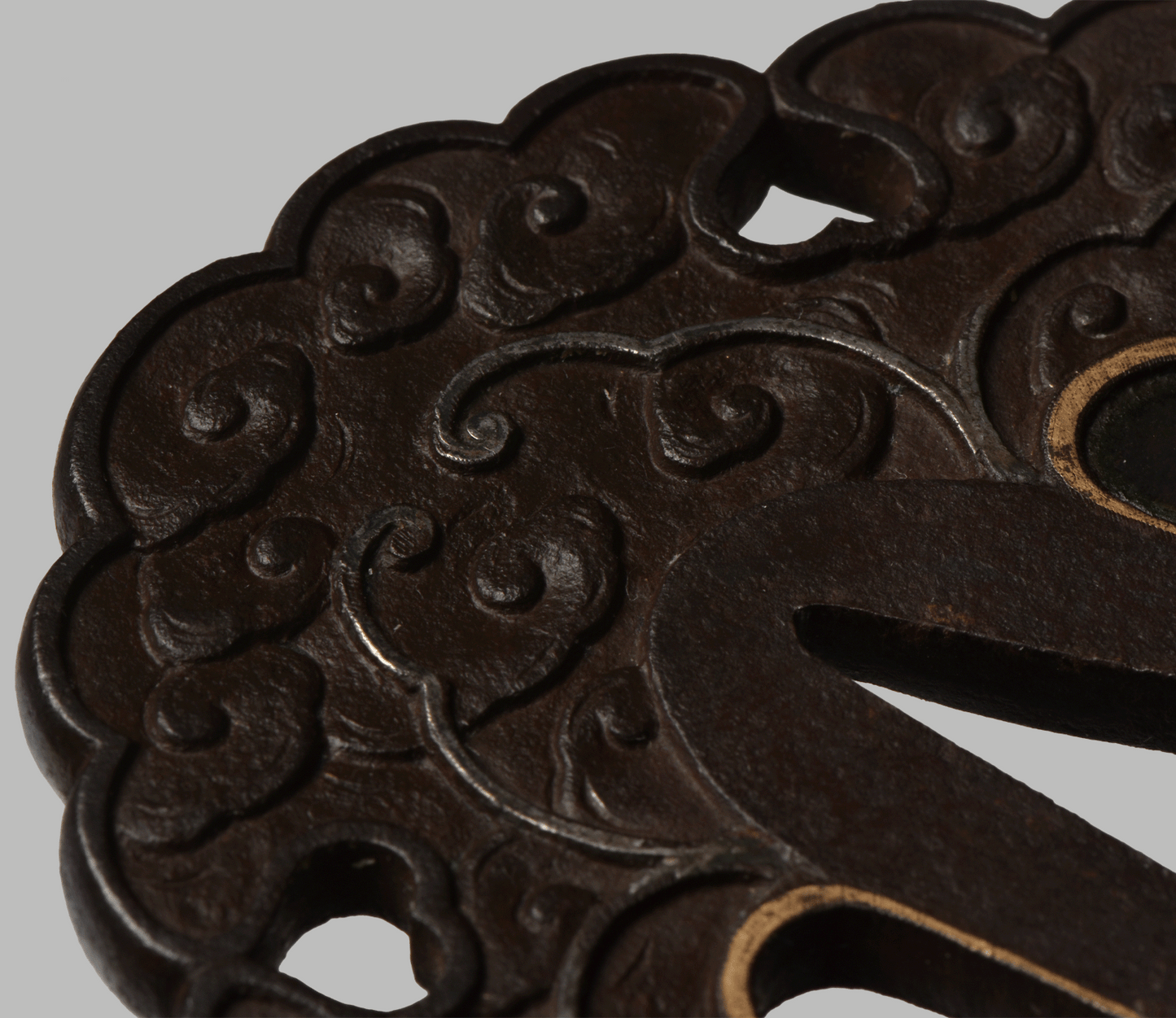
Cette tsuba, attribuée à l' école Futakoyama (二子山派), présente un kumo-mon (雲文, motif de nuage) richement sculpté, disposé en relief tourbillonnant sur une plaque ovale. Toute la surface est dominée par des formes de nuages dynamiques et sinueuses, rendues avec un modelé doux et une impression de mouvement atmosphérique, caractéristiques du vocabulaire décoratif de l'école. Le bord suit un contour ondulé, épousant le rythme des couches de nuages, conférant à la tsuba une silhouette sculpturale plutôt qu'un simple profil circulaire. Les hitsu-ana sont encadrés de traces de nunome-zōgan (布目象嵌, marqueterie de motifs textiles) en or, un raffinement qui contraste avec le socle en fer sombre et bien forgé. La plaque présente un martelage maîtrisé et une texture subtile, typiques de l'artisanat du milieu de l'époque d'Edo, exécutés avec la tendance de l'école Futakoyama à l'élégance et à la sobriété ornementale.
Dans l'interprétation de ce motif, le nuage revêt une profonde symbolique au sein de l'esthétique japonaise. Les nuages évoquent la transformation, le mouvement invisible des cieux et la frontière mouvante entre le monde terrestre et le divin. Dans la culture samouraï, une telle imagerie pouvait refléter les idéaux de mujō (無常, l'impermanence) et d'ouverture au changement, ou encore l'aspiration à une plus grande clarté d'esprit. Les nuages apparaissent également dans la littérature classique et l'iconographie du théâtre nô, suggérant un guerrier cultivé, sensible aux thèmes poétiques et cosmologiques. La fluidité des formes tourbillonnantes sur cette tsuba a probablement séduit un samouraï qui appréciait un symbolisme subtil plutôt qu'une imagerie martiale ostentatoire.
Un samouraï choisissant une telle tsuba cherchait peut-être à exprimer une grande maîtrise de soi et un raffinement certain, s'inscrivant ainsi dans une esthétique de puissance tranquille. Le motif du nuage pourrait suggérer une clairvoyance stratégique – à l'image des nuages qui dissimulent ou révèlent le ciel – ou une allusion à un guerrier agile et adaptable. De plus, la rareté de l'école Futakoyama indique que son propriétaire appréciait sans doute les objets issus d'écoles moins conventionnelles, soulignant ainsi son individualité et son goût pour l'art.
École probable et date : École Futakoyama (二子山派), milieu-fin de la période Edo (XVIIIe-XIXe siècle) .
Le Tsuba-dai sera inclus, mais il n'y a pas de boîte adaptée .
Dimensions : 79,8 mm × 85,0 mm × 4,5 mm (4,7 mm) ; poids : 127,3 g
Partager